Neutral hydrogen in numerical simulations
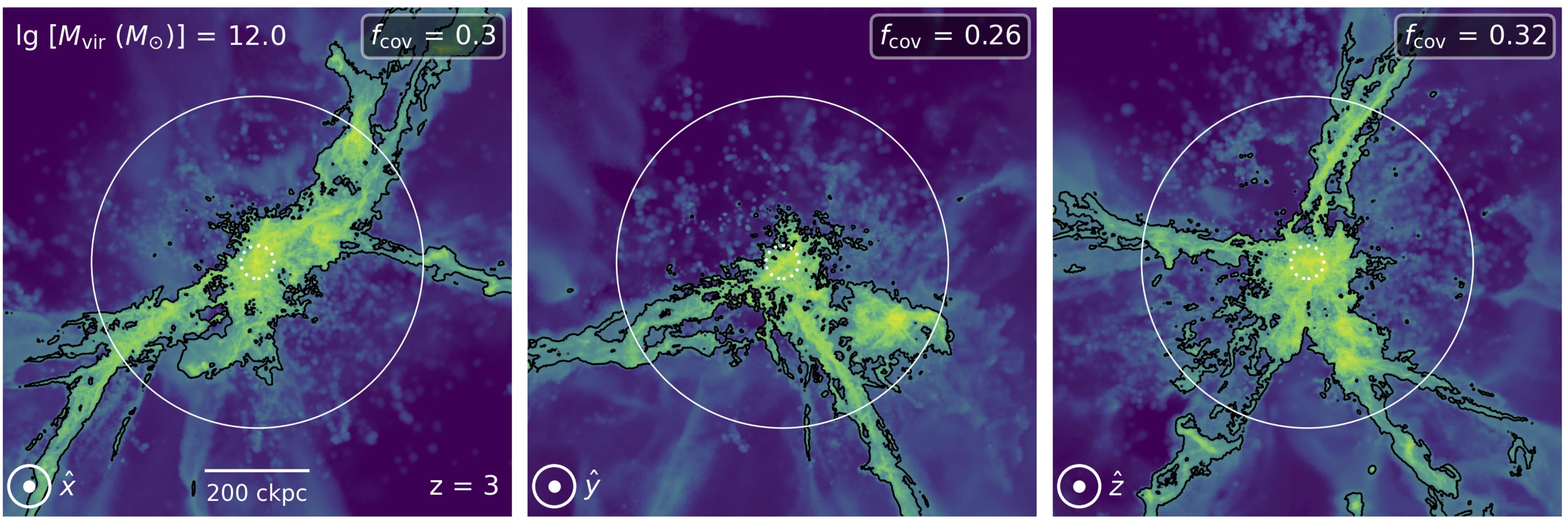
The figure above shows the distribution of neutral hydrogen column density in and around a \(10^{12} \ \mathrm{M}_\odot\) halo at \(z=3\) from the FIREbox simulation.
As part of a summer internship at the University of Zurich in Robert Feldmann's group (co-supervised by Mauro Bernardini), I studied the distribution of neutral hydrogen (\(\mathrm{HI}\)) in simulations (FIREbox & MassiveFIRE) from the Feedback In Realistic Environments (FIRE) project.
We published our results in the article: The \(HI\) covering fraction of Lyman Limit Systems in FIRE haloes (Tortora, L., Feldmann, R., Bernardini, M., & Faucher-Giguère, C.-A., 2024, MNRAS, 532, 3847).
Check it out here:



Abstract: Atomic hydrogen (\(\mathrm{HI}\)) serves a crucial role in connecting galactic-scale properties such as star formation with the large-scale structure of the Universe. While recent numerical simulations have successfully matched the observed covering fraction of \(\mathrm{HI}\) near Lyman Break Galaxies (LBGs) and in the foreground of luminous quasars at redshifts \(z\lesssim 3\), the low-mass end remains as-of-yet unexplored in observational and computational surveys. We employ a cosmological, hydrodynamical simulation (FIREbox) supplemented with zoom-in simulations (MassiveFIRE) from the Feedback In Realistic Environments (FIRE) project to investigate the \(\mathrm{HI}\) covering fraction of Lyman Limit Systems (\(N_{\mathrm{HI}} > 10^{17.2} \ \mathrm{cm}^{-2}\)) across a wide range of redshifts (\(z=0-6\)) and halo masses (\(10^{8}-10^{13} \ \mathrm{M}_\odot\) at \(z=0, 10^{8}-10^{11} \ \mathrm{M}_\odot\) at \(z=6\)) in the absence of feedback from active galactic nuclei. We find that the covering fraction inside haloes exhibits a strong increase with redshift, with only a weak dependance on halo mass for higher mass haloes. For massive haloes (\(M_{\mathrm{vir}} \sim 10^{11} - 10^{12} \ \mathrm{M}_\odot\)), the radial profiles showcase scale-invariance and remain independent of mass. The radial dependence is well captured by a fitting function. The covering fractions in our simulations are in good agreement with measurements of the covering fraction in LBGs. Our comprehensive analysis unveils a complex dependence with redshift and halo mass for haloes with \(M_{\mathrm{vir}}\ \lesssim 10^{10} \ \mathrm{M}_\odot\), that future observations aim to constrain, providing key insights into the physics of structure formation and gas assembly.