The low surface brightness environment of Milky Way-mass galaxies
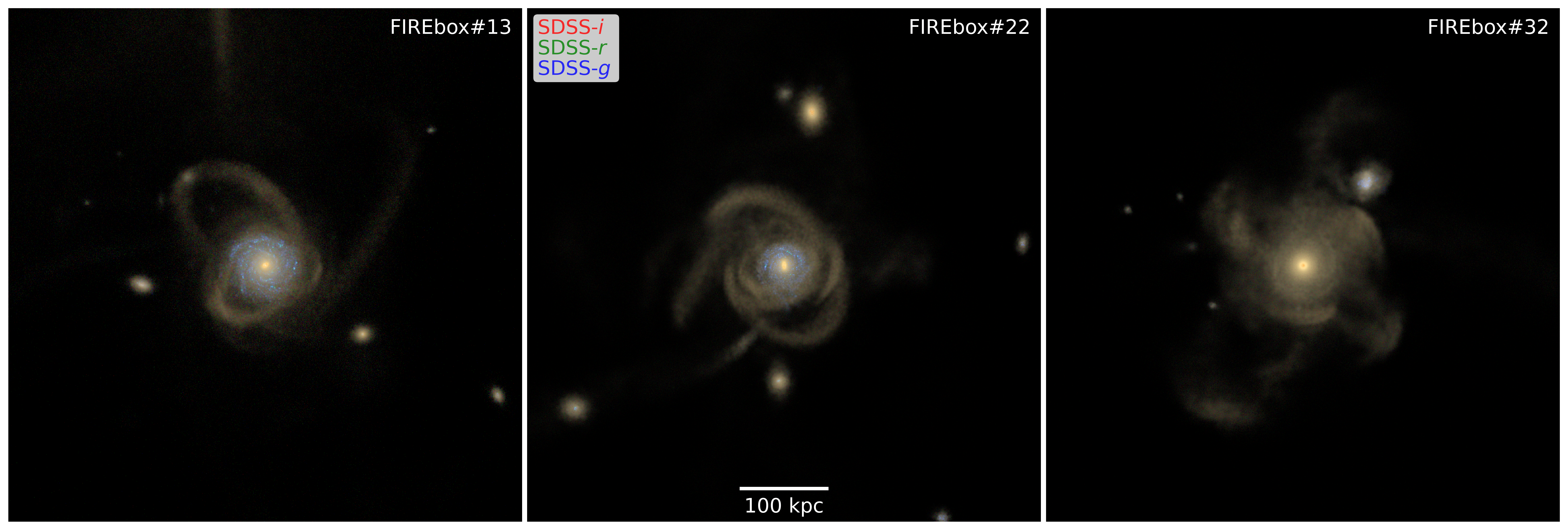
The figure above shows gri-colour mock images of Milky Way-mass galaxies from the FIREbox simulation. Note the presence of multiple satellite galaxies and various tidal features (streams, shells) in the surroundings of the central galaxy in each panel.
I conducted my MSc thesis at the University of Zurich, co-supervised by Robert Feldmann (UZH) and Judit Szulágyi (ETHZ). We extracted Milky Way-mass galaxies at \(z=0\) from the FIREbox suite of simulations and created a catalogue of surface brightness maps using the SKIRT9 radiative transfer code. I then continued this work as a research assistant at UZH and École Polytechnique Fédérale de Lausanne (EPFL) under the additional supervision of Yves Revaz and Pascale Jablonka, and in collaboration with the WP1-COS and WP2-GAL teams of the ARRAKIHS Mission Consortium (AMC).
Our work consisted in developing tools to automatically detect and segment various features in the surroundings of these galaxies. Namely, we focused on the study of satellite galaxies and the low surface brightness features (LSBFs) that emerge from the gravitational interaction between the central galaxy and its environment. These features are key observables that we aim to use to distinguish between different flavours of dark matter and better understand the role of baryonic physics and its implementation in numerical simulations.
The work we carried out within the AMC serves as the theoretical basis for the scientific goals of the ARRAKIHS mission.
I also contributed to the calibration and development of the pNbody code, which we use to rapidly generate
surface brightness maps of galaxies (amongst other things).
We are currently preparing publications on this work, stay tuned for future updates!