Research
As we understand it, the evolution and growth of structure from the Early Universe until today can only be explained with dark matter that manifests uniquely through gravity. Observations of kpc size sub-structures suggest that dark matter clumps efficiently and hence should be cold (have negligible thermal velocity). However, the Standard Model (SM) of physics contains no viable candidate, requiring a SM extension. The most popular one proposes a heavy (GeV-TeV) and weakly interacting particle (to have the right dark matter abundance and lifetime), which has not been detected after decades of experimental effort, motivating astrophysical research into alternative dark matter candidates.
The Lyman-α forest precisely probes this regime just after the first formed stars and galaxies ionize the intergalactic medium (IGM), which traces the dark matter distribution. At the same time, the Lyman-α forest is sensitive to the physics of reionization, including the thermal evolution of the IGM. As such, the Lyman-α forest stands as a unique probe of the nature of dark matter and of the astrophysical processes triggered by the first reionization sources.
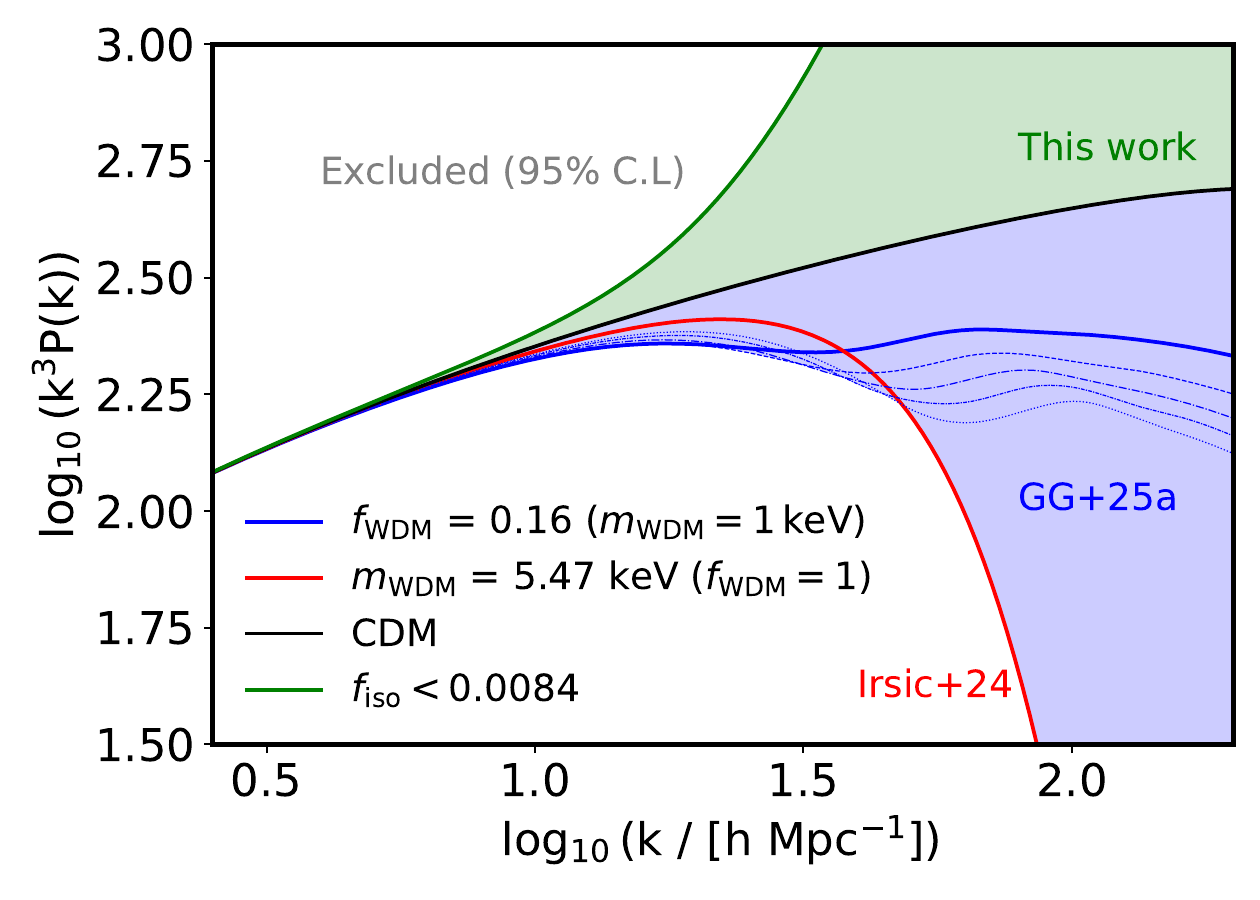
My PhD research investigates precisely these questions! Some of the most interesting results, in terms of constraints on the matter power spectrum at z = 0, are shown below, where the colored regions mark models allowed within 2σ by the analyses described below.
1. Constraining Mixed Dark Matter models with high redshift Lyman-α forest data
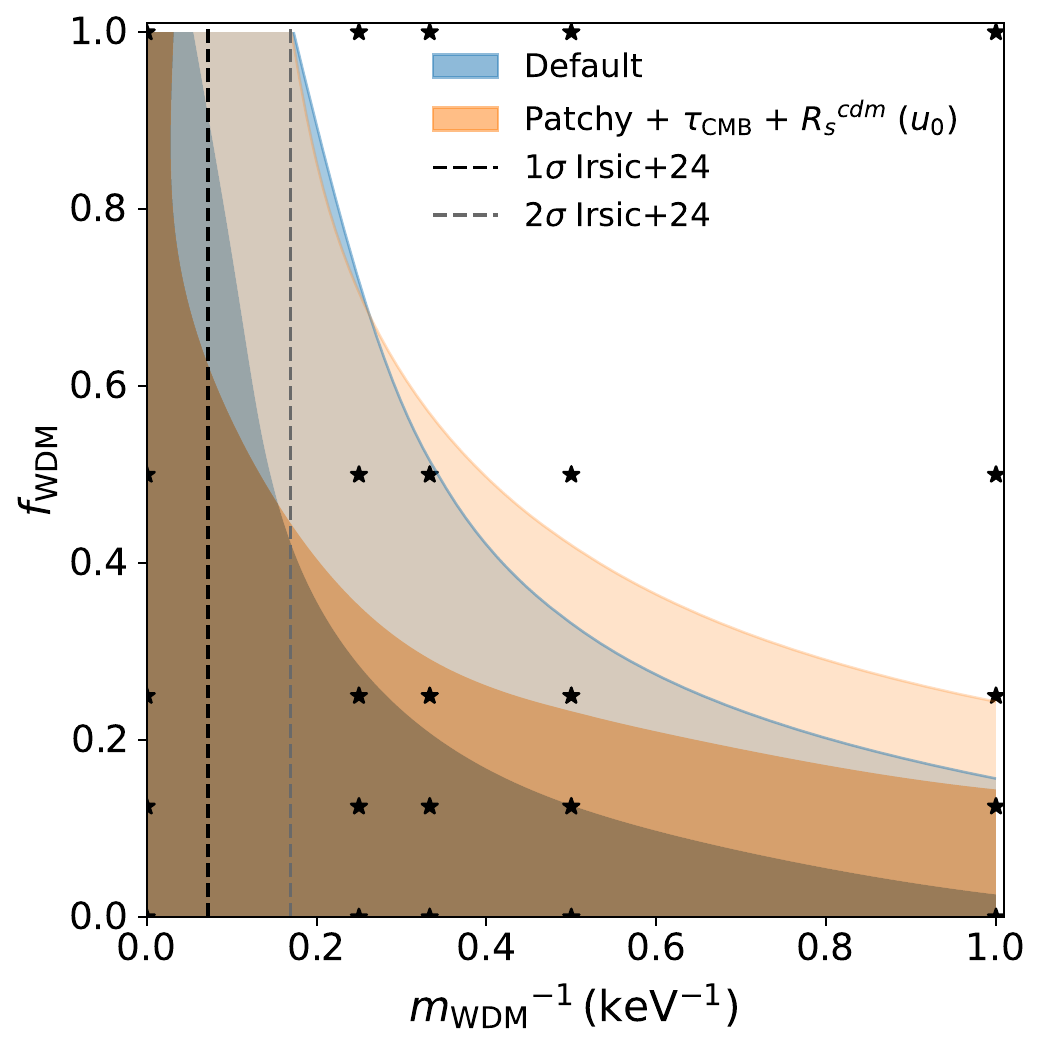
In this work, I present updated constraints on Cold+Warm Dark Matter (CWDM) models, which suppress structure formation at the small-scales probed by the Lyman-α forest. This relies on a new set of simulations based on the Sherwood-Relics suite (Puchwein et al. 2019), which capture the CWDM free-streaming properties and the complex gas physics dominating the same (small) scales. We further use the Boera et al. 2019 data, which consists of 1D flux power spectrum measurements from high-resolution quasar spectra (z = 4.2–5.0) from UVES and HIRES. I compared the simulations with the data within a Bayesian analysis framework.
A key advancement of the analysis is the integration of a NN emulator at the likelihood level, which significantly speeds up the analysis compared to previous work (Irsic et al. 2023). I further explored different thermal priors and the impact of mass resolution correction, following Irsic et al. 2023. The results reveal that a thermal relic as warm as 1 keV is allowed for a fraction < 0.16 (95% C.L.), while larger masses are also viable with larger mass fractions.
2. Constraints on the Thomson optical depth to the Cosmic Microwave Background from the Lyman-α forest
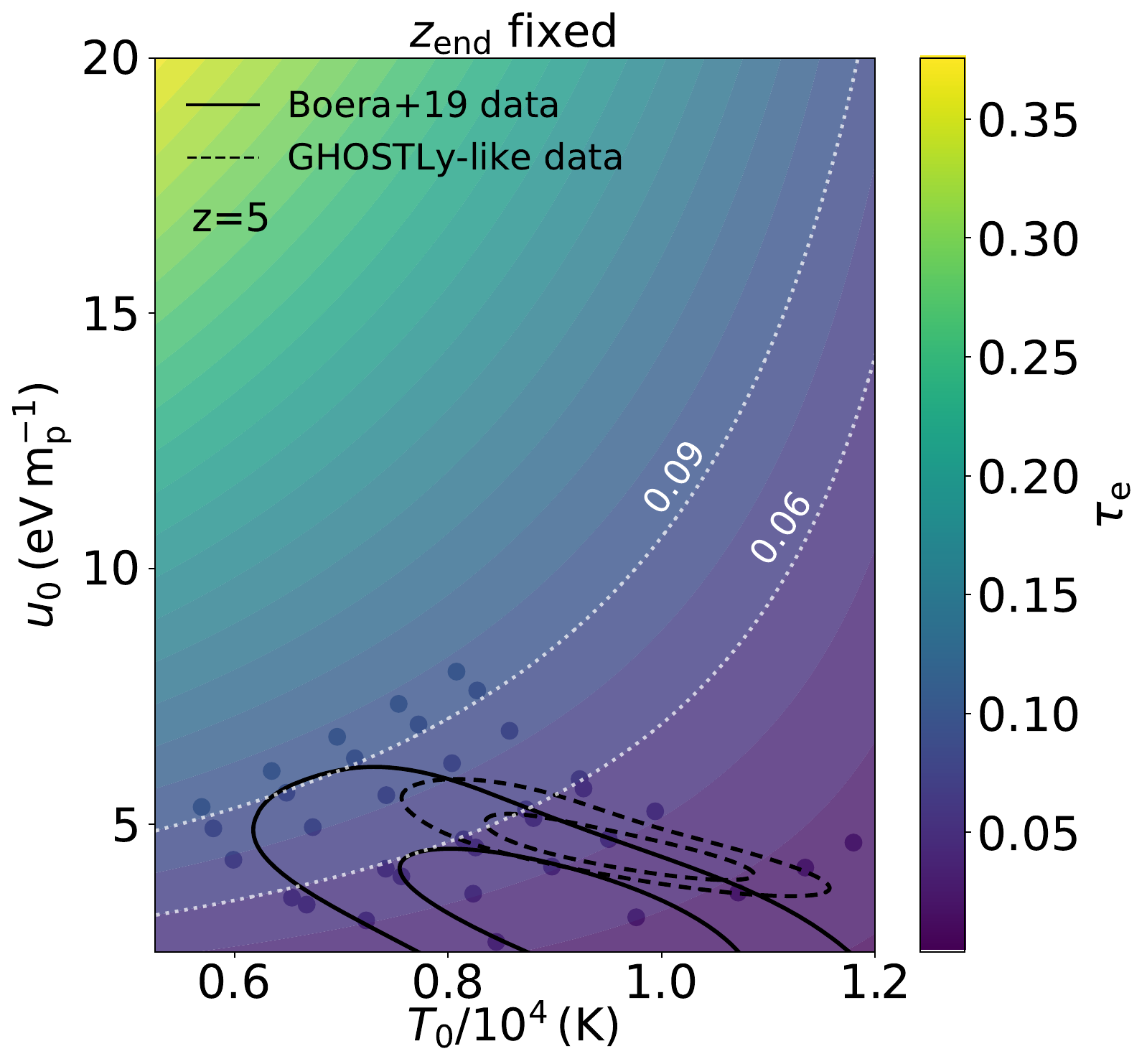
Motivated by recent suggestions that large values of the electron optical depth to reionization, τe, could alleviate the preference for physics beyond ΛCDM suggested by DESI DR2, this work investigates the constraining power of the Lyman-α forest alone on τe.
The resulting τe constraints are consistent with Planck, but exhibit a mild tension at the 2.4σ and 2.8σ level for the zend and Δz-fixed models, respectively, with the values suggested by Sailer et al. 2025, Jhaveri et al. 2025.
3. Post-inflationary axion constraints from the Lyman-α forest
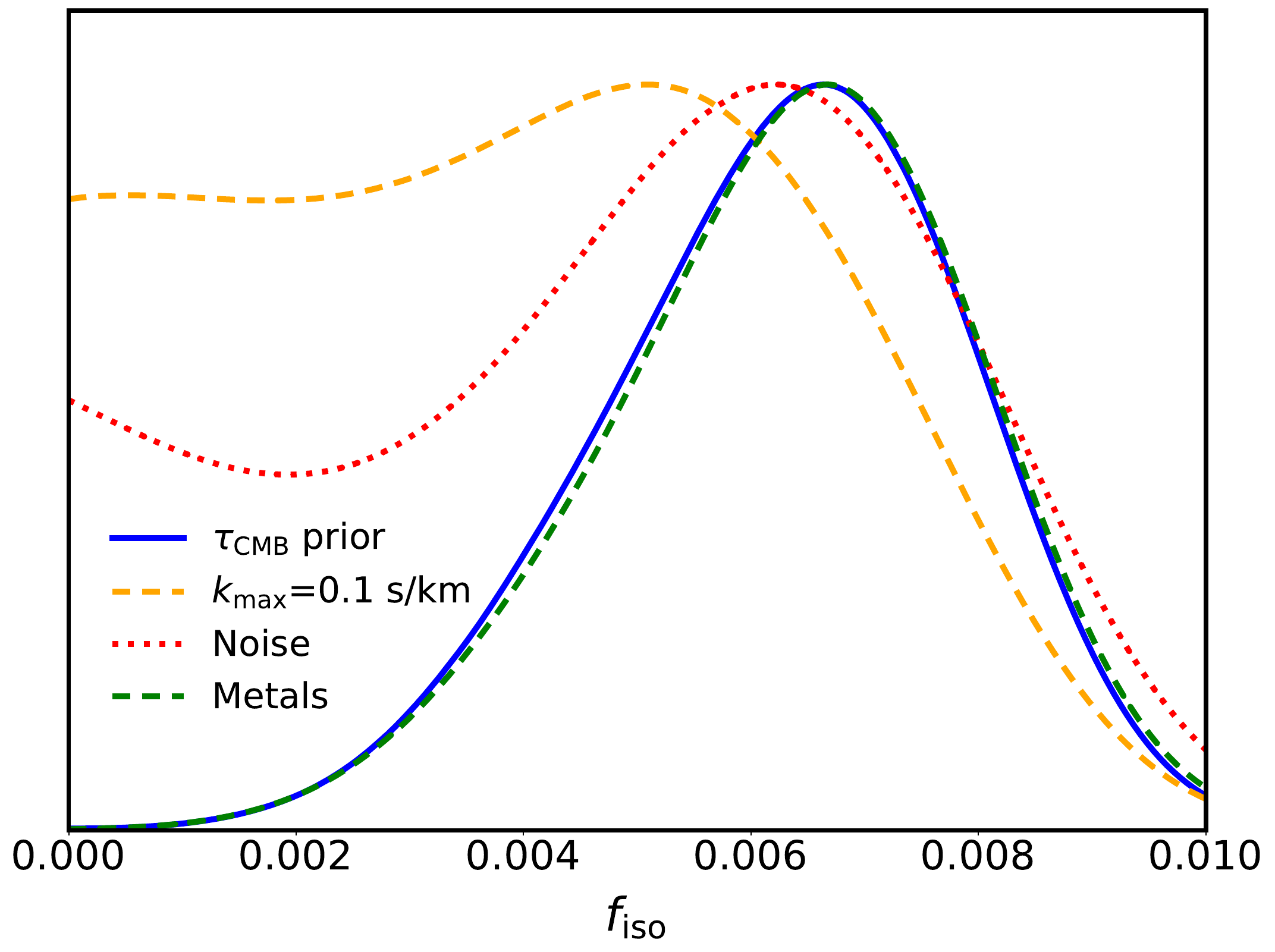
In this paper I present new constraints on a dark matter candidate in the ultra-light regime, axion-like particles (ALPs). The ALPs are produced through the misalignment mechanism when a Peccei-Quinn (PQ)-like symmetry is spontaneously broken after inflation, causing the initial vacuum misalignment angle to fluctuate across causally disconnected regions of the Universe. As a result, ALPs generate a white-noise (isocurvature) spectrum of perturbations.
The analysis constrains the isocurvature fraction, fiso, which quantifies the contribution of isocurvature fluctuations relative to adiabatic perturbations at the pivot scale k* = 0.05 Mpc−1. The simulations are run with different initial conditions including the isocurvature component, Δ2iso(k) ∝ kniso−1, where niso is the isocurvature spectral index. Throughout this work, niso = 4 is kept fixed, which is the case of post-inflationary axions discussed earlier (as well as of primordial black holes). The results reveal a tentative detection of fiso = 0.0064+0.0012−0.0014 (68% C.L.), driven by the improved fit to the Boera et al. data, which is consistent with the findings of Pavičević et al. 2025 for primordial magnetic fields models.
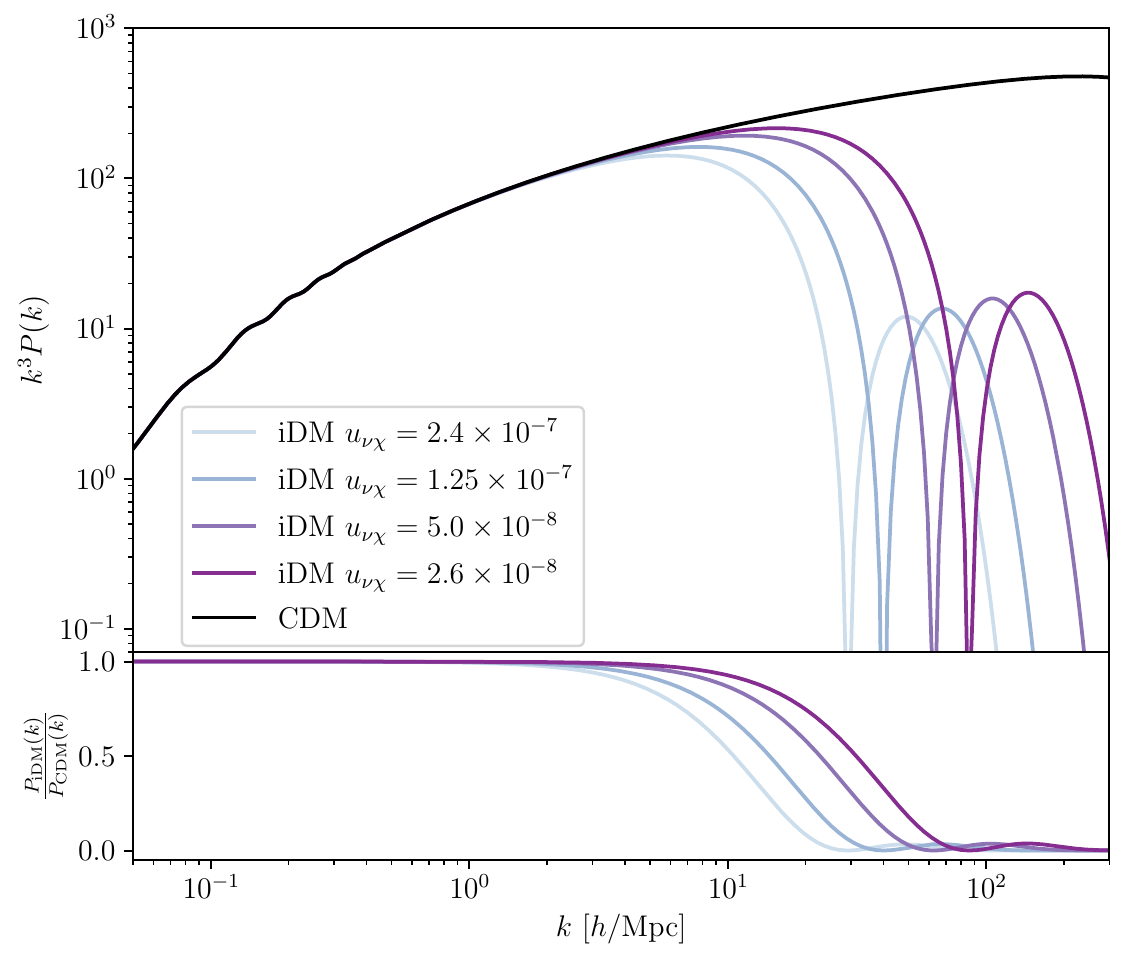
4. High resolution Lyman-α forest constraints on dark matter-neutrino scattering
Building on this work outlined above, I recently co-authored a paper constraining dark matter–neutrino interaction models, motivated by recent studies favoring such interactions (e.g., Hooper & Lucca 2022; Giarè et al. 2025).
For the interaction strength parameter, we found a preference for uνχ ≤ 1.5×10⁻⁸ (95% C.L.), setting the strongest direct bound to date on such interactions.